The Reserve Bank of Malawi (RBM) says it has noted positive signs from commercial banks, which have increased lending to the private sector, especially in productive sectors.
Data contained in the RBM Financial and Economic Review for Q3 show that private sector credit surged to 48.9 percent between July and September 2025.
This is a rise from 26.3 percent in Q2 and 24.2 percent in Q3 of 2024, according to the central bank.
In his remarks after meeting chief executive officers of the country’s commercial banks in Lilongwe on Friday, RBM Governor MacDonald Mafuta Mwale commended the banks for increasing lending to core productive sectors in agriculture, tourism, mining and manufacturing, saying this is critical to achieve economic growth.
“Shifting our economy onto a sustainable path requires this exact focus: empowering the private sector as the primary engine of production and export growth,” he said.
Mafuta Mwale emphasised that strengthening linkages with productive enterprises is fundamental to achieving meaningful and lasting economic transformation while stressing commercial banks’ role in bolstering foreign exchange reserves.
“For Malawi to significantly build its foreign exchange reserves and stabilise the exchange rate, banks must lead in mobilising export proceeds and diaspora remittances,” he said.
In an interview on Tuesday, Bankers Association of Malawi president Phillip Madinga commended the RBM for its continued engagement with bankers on critical issues that underpin financial stability and economic development.
He stressed the importance of maintaining open communication throughout the process while noting the banks’ growing interest to lend to private sector, which is the engine of the economy.
Madinga, who is Standard Bank plc chief executive, said stability in asset quality means banks are better equipped to extend credit to productive sectors, thereby reinforcing their role as catalysts for inclusive growth and financial sector development.
“The expectation is that with potential new pro-private sector policies from the new government, we could see more improvements in the medium to long-term,” he said.
An analysis of the distribution of the private sector credit shows the shift from community, social and personal loans to lending towards manufacturing, agriculture and wholesale and retail sectors, among others.
For instance while the community social and personal loans have been dropping from 42.5 percent of the total private sector lending in Q1 to 37.8 percent in Q2 and 35.5 percent in Q3, manufacturing sector has been rising from 11.7 percent, 21.2 percent and 23.6 percent respectively in the past three quarters.
The RBM report shows that private sector credit stood at K2.2 trillion in Q3 with expansions being registered in manufacturing, wholesale and retail, community, social and personal services, agriculture, forestry, fishing and hunting among others.
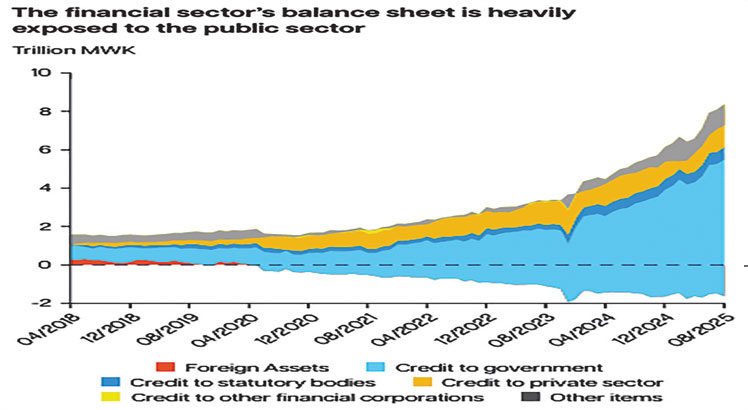
Meanwhile, total credit from the banking system to the domestic economy increased to K10.6 trillion from K9.4 trillion driven by expansions in credit to the central government, private sector and public non-financial
corporations.
The report further indicates that government deposits with commercial banks improved during the quarter with increased inflow of donor funding, which reduced its net credit during the quarter while boosting private sector credit access.
In an interview on Tuesday, economist Gilbert Kachamba said the growth in private sector credit suggests that banks are now apprehensive about lending to government based on how much domestic debt has ballooned over the past couple of years.
The country’s public debt is
currently at K28 trillion, with 60 percent of it being domestic debt, according to Minister of Finance, Economic Planning and Decentralisation Joseph Mwanamvekha.
Said Kachamba: “The banks would rather lend to the private sector now and they can afford to take on a bit of risk since they are sitting on healthy levels of liquidity.”
Financial market analyst Brian Kampanje described the increased private sector credit as positive, observing the trend of improved credit access by key sectors such as manufacturing.
“There is, however, a positive trajectory in the manufacturing sector as credit increased from 21 percent of the total lending to the private sector to 23.6 percent in Q3,” he said.
Speaking during the bank’s Investor Day in Lilongwe earlier this year, Standard Bank plc
head of personal and private banking Charity Mughogho said although the bank lends significantly to government, its K400 billion loan book also consists of considerable customer loans to ensure it balances up.
Economists content that increased private sector lending boosts investments by encouraging businesses to invest in new projects, enhances consumption by increasing consumer spending, supports economic growth through provision of steady flow of funds to various sector and promotes job creation by helping businesses to grow, resulting in jobs growth.